Quickly obtain molecular migration speed in specific environments, analyze diffusion paths and energy barriers, and assist in predicting material properties and structural design
Free diffusion simulation is an important method for studying molecular movement behavior in unconstrained or specific environments. By tracking molecular movement trajectories, we can quantitatively analyze key parameters such as diffusion coefficients and migration rates. These data are of great significance for understanding material transport properties, optimizing separation processes, and designing new functional materials.
QuantA Molecule's free diffusion simulation service adopts advanced molecular dynamics methods combined with high-performance computing technology. It can efficiently simulate the diffusion behavior of various molecules under different temperature and pressure conditions, providing customers with accurate and reliable data analysis results.
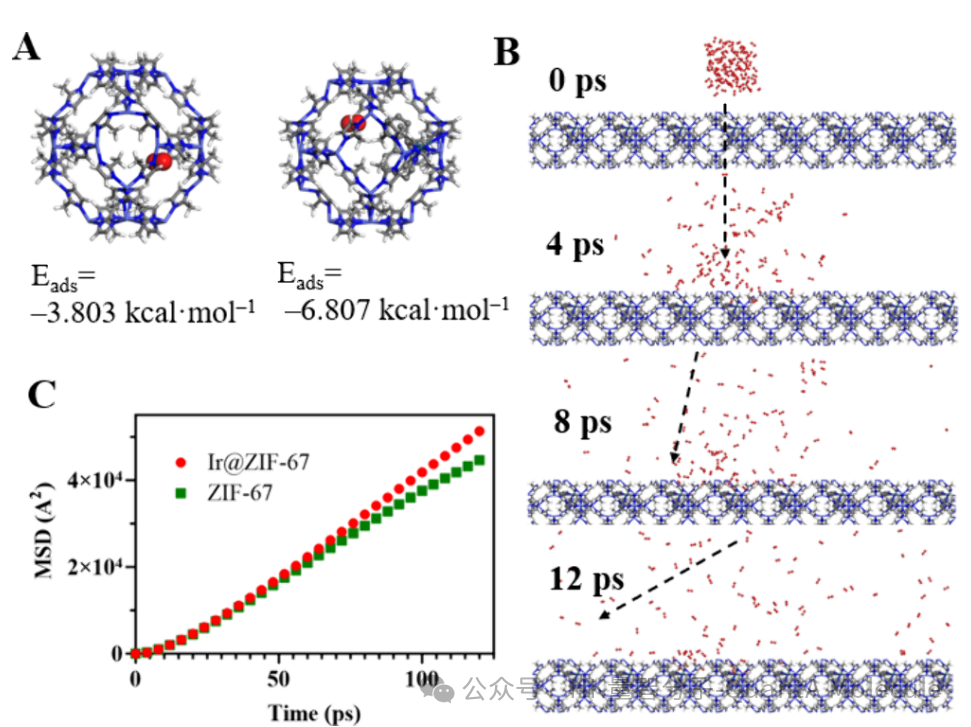
The figure above shows the adsorption behavior of molecules in Metal-Organic Framework (MOF) materials. By calculating the binding energy (Eads) at different adsorption sites, we can predict the main adsorption positions and strengths of molecules in the material. The binding energies of two different adsorption sites in the figure are -3.803 kcal·mol-1 and -6.807 kcal·mol-1, indicating that the red molecule has stronger binding ability at the right site.
These adsorption data are crucial for understanding the initial state and diffusion starting point of molecules in materials, directly affecting the calculation results of subsequent diffusion paths and energy barriers.
The right part of the figure shows the diffusion trajectory of molecules at different time points (0 ps, 4 ps, 8 ps, 12 ps), clearly presenting how molecules migrate through material channels. The left MSD (Mean Square Displacement) curve provides quantitative analysis, with the red curve representing ZIF-67 material loaded with Ir metal and the green curve representing pure ZIF-67 material.
It can be seen from the MSD curve that the molecular diffusion rate in Ir-loaded materials is significantly higher than that in pure materials, indicating that metal modification can effectively improve the transport properties of materials. The diffusion coefficient can be calculated through the slope of the MSD curve, providing important basis for material performance optimization.

| Material Type | Binding Energy (kcal·mol-1) | Diffusion Coefficient (×10-8 cm2/s) | Migration Rate Improvement |
|---|---|---|---|
| ZIF-67 (Pure Material) | -3.803 | 2.4 | Reference |
| Ir@ZIF-67 (Metal-Loaded) | -6.807 | 3.8 | +58.3% |
Through free diffusion simulation, we successfully predicted the path and energy barrier of drug molecules passing through cell membranes, providing an important basis for drug design. The simulation results show that drug molecules mainly diffuse through membrane protein channels rather than directly passing through the phospholipid bilayer.
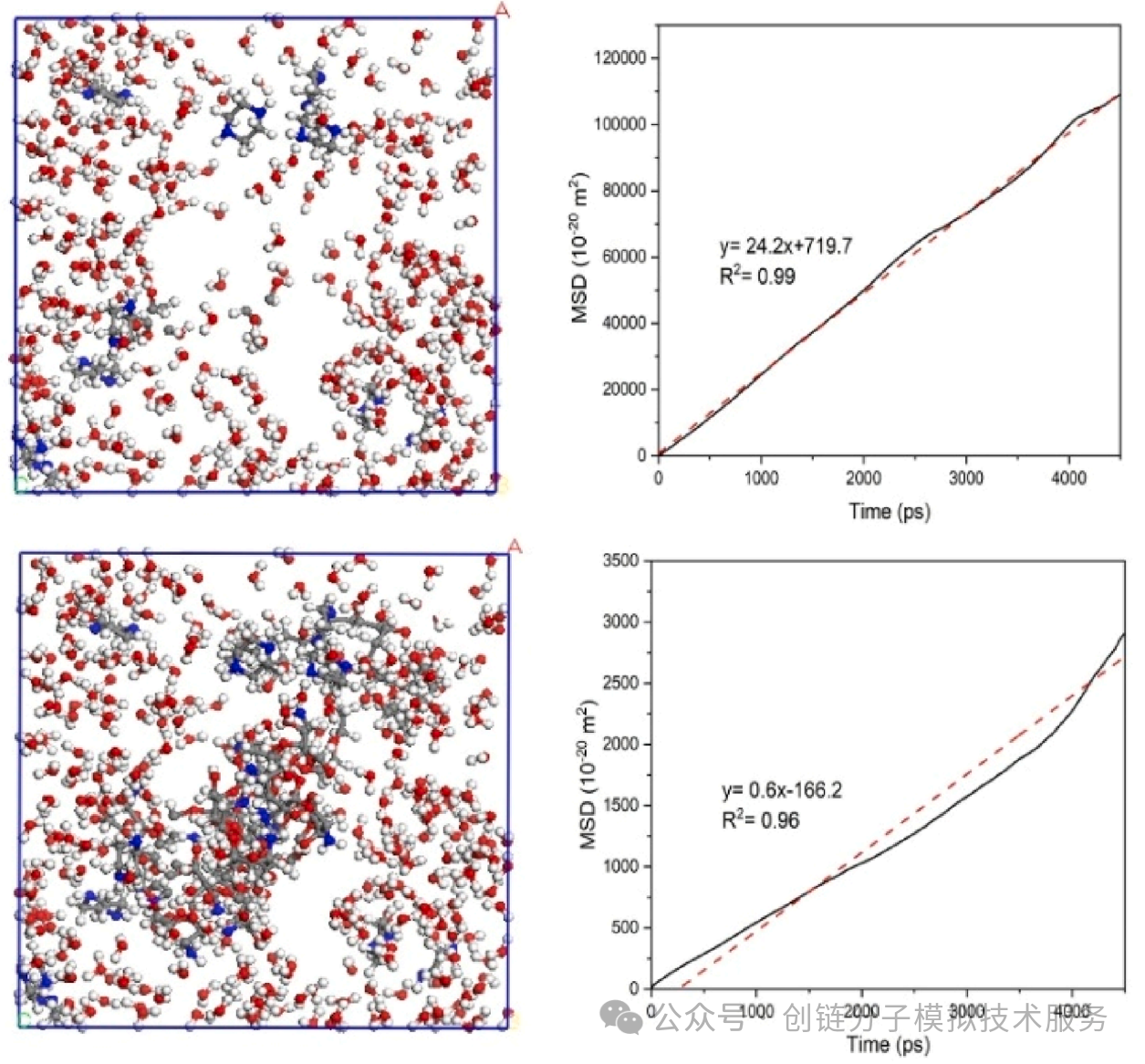
For fuel cell proton exchange membranes, we simulated the diffusion mechanism of water molecules under different humidity conditions. The study found that the formation of water channels is the key to improving proton conductivity, which provides new ideas for designing high-performance fuel cell membrane materials.
Classical Molecular Dynamics (MD) simulation, using COMPASS force field
Up to 100 nanoseconds (ns) to ensure sufficient sampling
Diffusion coefficient, MSD curve, radial distribution function (RDF), trajectory files, etc.
Supports simulations under different temperature (273-473K) and pressure conditions
Study the behavior of molecules in external electric fields, providing important insights for energy storage materials and molecular electronics design.
Simulate material properties under high pressure conditions, with applications in geological exploration, high-pressure synthesis, and material design.
Analyze molecular adsorption mechanisms on material surfaces, providing important guidance for gas separation, catalysis, and environmental protection.
Scan the QR code to add us
Contact us now to learn how our molecular simulation services can accelerate your research and development process
Get Started